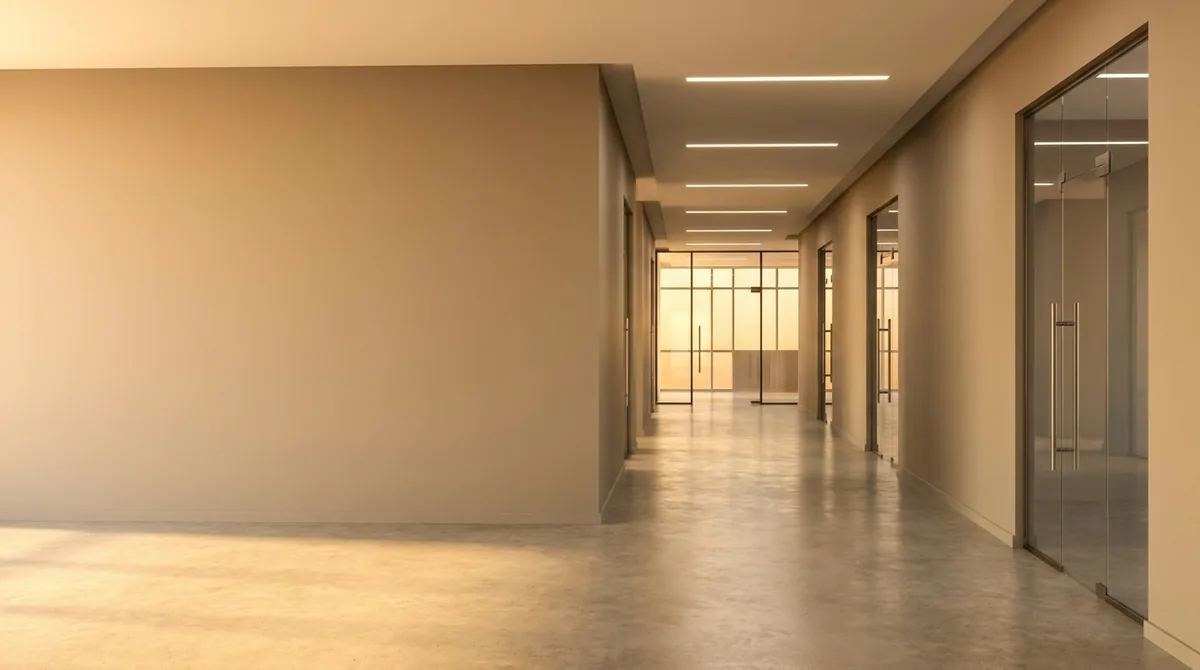
Commercial
A commercial repaint doesn't have to mean closing your doors. The three tools that make this work are off-hours or overnight scheduling, phased/sectioned work that keeps parts of the space operational while others are painted, and low-odor, fast-cure products that let spaces be reoccupied sooner than traditional paint allows.
The right approach depends heavily on your business type — a retail storefront, a medical office, and a corporate headquarters all have different constraints, and a contractor experienced in commercial work should be asking about your operating hours and foot traffic before proposing a schedule, not after.
For most office environments, painting after close and finishing before staff arrive the next morning is the simplest way to have zero impact on daytime operations. This typically means an evening start (often after 6-7pm) with cleanup and ventilation completed before the first employees arrive, which is very achievable with proper crew sizing and planning for the space.
This approach works especially well for standard 9-to-5 office environments, professional services, and corporate spaces where the building is genuinely empty overnight. It's less practical for spaces with any overnight staff or 24-hour operations, where phased sectioning becomes the better tool.
Retail locations, medical offices, and businesses that need to remain accessible during standard hours benefit more from a sectioned approach — painting one wing, floor, or department at a time while the rest of the space stays operational, then rotating through the full space over a longer calendar timeline rather than a single closure.
This requires more detailed upfront planning (temporary barriers, dust/odor containment between sections, clear communication with staff about which areas are active work zones on which days) but avoids any full-business closure, which matters most for customer-facing operations that can't simply shut down for a week.
Low-VOC and zero-VOC paints have become standard for commercial work partly for air quality reasons, but also because they typically have less lingering odor — a real factor for reoccupying a space quickly, especially in medical offices or anywhere with odor-sensitive occupants. Fast-cure formulas can also shorten the window between "paint applied" and "safe to fully reoccupy and use the space normally," which matters when you're working around a tight operational schedule.
For projects requiring off-hours or weekend work, 2-4 weeks lead time is typical to properly plan crew scheduling around your specific hours and coordinate any building access requirements.
There's often a modest premium for evening/overnight or weekend-only labor, but it's typically far less than the cost of lost business from a full closure — most commercial clients find it's a clear net positive.
Yes — we move and protect furniture, electronics, and equipment as standard practice, though very heavy or specialized equipment sometimes needs coordination with your team to relocate ahead of the scheduled work.
This is exactly where low-VOC/zero-VOC product selection combined with off-hours scheduling and proper ventilation makes the biggest difference — we plan product choice specifically around this concern for sensitive environments like medical offices.
Tell us your hours and constraints — we'll build a schedule and quote around them, not the other way around.
Real price ranges for Carmel interior repaints, broken down by room and square footage — plus the five factors that actually move your number up or down.
Read MoreMay through early October is the real window for exterior painting in Central Indiana — but the calendar matters less than temperature, humidity, and dew point on the actual application day.
Read MoreSeven to ten years is the honest average for a properly prepped exterior repaint in Central Indiana's freeze-thaw climate — here's what actually shortens or extends that number.
Read MoreTell us about your project — no cost, no obligation. We'll follow up with a written quote.